Saturday, 12 May 2012

Gay marriage: three key factors behind voting for bans


Interesting Guardian article here with research into why people vote against same sex marraige. It's not just about religion...

Gay marriage: three key factors behind voting for bans

With high levels of religious adherence, North Carolina voters followed a predictable pattern. But that's not the whole story
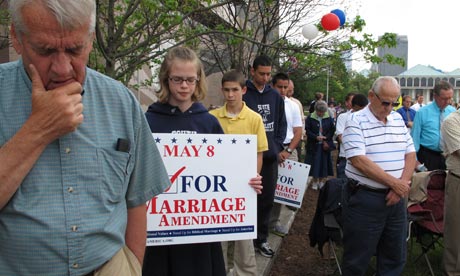
    People pray supporting a constitutional ban on gay marriage in Raleigh, North Carolina
    North Carolina voters passed a constitutional ban on same-sex marriage and civil unions Tuesday night. The reaction in the Twitterverse can be described as anger and hurt. Many probably thought to themselves that such a decision by the voters was "backward".

    I have discussed how voter opinion on same-sex relationship issues is complex, but there isn't anything difficult to understand why Amendment 1 or any other constitutional ban on same-sex marriage pass.

    Support for bans between states is highly predictable simply by knowing the percentage of religious voters. Many times, however, what explains differences between states' support does not explain how votes differ within a state.

    Two years ago, I ran a simple regression on three recently voted-upon ballot bans on same-sex marriage in Arizona (2006), California (2008), and Maine (2009). I wanted to examine whether the percentage of religious adherents, taken from the Association of Religion Data Archives (ARDA), within a state could explain county-to-county variance in support of marriage bans. I also added variables for partisanship (as measured by Obama's 2008 vote percentage) and for educational attainment (as measured by the percentage of voters within each county with at least a bachelor's degree, according to census figures).

    What I found many would call predictable: 89-93.5% of the variation in vote for same-sex marriage amendments could simply be accounted for these three variables.

    Counties were less likely to vote for a ban if their voters were better-educated, more Democratic, and less religious. Importantly, equations such as these control for the fact that some counties might be quite Democratic and less religious, but have a high percentage of less well educated folk. In that case, these counties are more likely to vote for the ban than those counties that are highly Democratic, less religious, but (on average) more highly educated.

    Continues here.

Friday, 11 May 2012

MLB Faces Antitrust Suit Regarding Its TV Blackout Policies

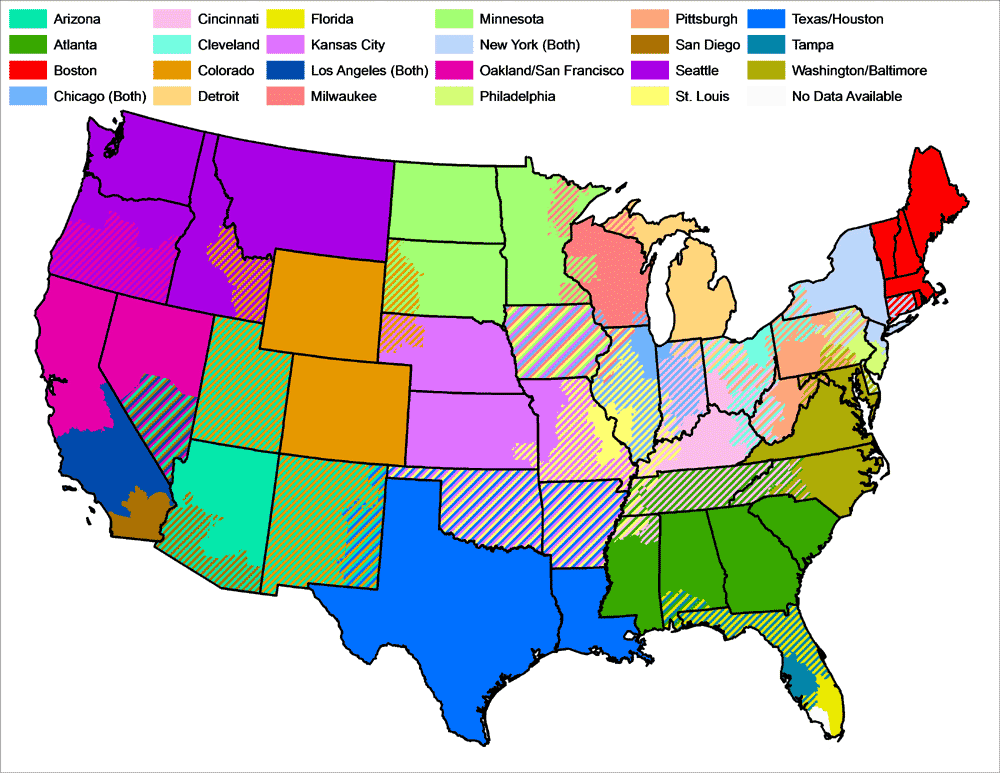
Major League Baseball's television blackout policies are the subject of a class action antitrust lawsuit that was filed on Wednesday in the Southern District of New York. The plaintiffs in Garber v. MLB allege that the league has violated Sections One and Two of the Sherman Act by unfairly restricting its fans' ability to watch out-of-market broadcasts in two primary ways. First, through its MLB Extra Innings cable package and MLB.tv Internet package, MLB refuses to offer fans the ability to purchase just their favorite team's games, instead requiring consumers to purchase a package including all out-of-market MLB broadcasts. Second, both the Extra Innings and MLB.tv packages blackout any games broadcast locally via a regional sports network (RSN), meaning that fans cannot use those packages to watch their local team play, but must instead purchase a cable subscription to watch the games on their local RSN. The complaint alleges that these exclusive broadcasting policies drive up subscription fees for all cable consumers by enabling the RSNs to charge monopoly prices for their highly desirable sports programming. The Garber plaintiffs' complaint is available here, while MLB's specific blackout policies are explained here (and depicted in the accompanying map).

The lawsuit was filed by the same law firm (Pomerantz, Haudek, Grossman & Gross) that filed a similar class action antitrust suit against the NHL in March 2012 (Laumann v. NHL). Two of the three named plaintiffs in the NHL case (Fernanda Garber and Robert Silver) are among the four named plaintiffs in the MLB lawsuit.

Interestingly, the Garber suit does not name all 30 MLB teams as defendants, instead suing only the Chicago Cubs, Chicago White Sox, Colorado Rockies, New York Yankees, Oakland A's, Philadelphia Phillies, Pittsburgh Pirates, San Francisco Giants, and Seattle Mariners, along with the Office of the Commissioner, MLB Advanced Media, DirecTV, Comcast, and various RSNs. Notably, the suit does not name any of the Fox Sports RSNs as defendants, nor any of the teams whose games are primarily broadcast on the Fox Sports networks. Instead, the suit targets only those teams whose games are televised on an RSN owned by DirecTV or Comcast (the one exception being the Yankees, who own their own proprietary RSN, the YES network). It is not immediately clear why the attorneys limited their allegations only to DirecTV and Comcast affiliates, but it may have something to do with a desire to pursue damages from cable service providers based on the allegations that all cable consumers have been charged higher prices due to MLB's exclusive broadcast policies.

One major hurdle the plaintiffs will have to overcome in their suit against MLB, of course, is baseball's historic exemption from antitrust law. Following the Supreme Court's 1972 decision in Flood v. Kuhn, lower courts have been divided regarding how broadly the exemption applies. As I explained in a recent law review article, subsequent lower courts have generally adopted one of three approaches to the exemption: (i) holding that the exemption broadly shields the entire business of baseball, (ii) holding that the exemption shields only the reserve clause (the specific restraint at issue in Flood), or (iii) holding that the exemption shields baseball's "unique characteristics and needs."

In Postema v. National League, 799 F. Supp. 1475 (S.D.N.Y. 1992), the Southern District of New York adopted the latter approach, holding that baseball's exemption did not shield the league from a suit filed by a former umpire because “[a]nti-competitive conduct toward umpires is not an essential part of baseball.” Id. at 1489. Undoubtedly hoping to draw upon this precedent and the related line of cases, the complaint in Garber argues that MLB's TV policies do not "reflect anything unique to baseball" insofar as "they are essentially identical to those in other major sports." Complaint at Paragraph 8.

The plaintiffs also seek to avoid application of the antitrust exemption by citing to Henderson Broadcasting Corp. v. Houston Sports Ass’n, 541 F. Supp. 263 (S.D. Tex. 1982), a case in which the Southern District of Texas ruled that the exemption did not apply to a dispute involving the Houston Astros' local radio broadcasting agreements. Based on this precedent, the Garber plaintiffs argue that the "distribution of video presentation of baseball games is subject to the antitrust laws." Complaint at Paragraph 8.

It will be interesting to see how the Garber court handles the antitrust exemption issue. Personally, I believe the "unique characteristics and needs" standard -- drawing upon dicta in Flood -- is flawed, given that the Supreme Court did not itself apply any such standard in the Flood case. I have similarly argued that the Henderson decision is poorly reasoned in several respects. As a result, I believe that baseball's broadcasting activities are encompassed by the exemption.  Nevertheless, the Postema and Henderson precedents could give the Garber court a potential basis for discarding baseball's antitrust exemption, if it is so inclined.

It will also be interesting to see if the Garber lawsuit finally motivates MLB to update its antiquated television blackout policies. The rules have been frequently criticized by baseball fans, and can lead to absurd outcomes such as fans in Iowa being unable to watch any game involving the Twins, Royals, White Sox, Brewers, Cubs, or Cardinals on either the MLB Extra Innings or MLB.tv packages, even though in many cases none of those teams' games are available from their local cable provider. MLB has reportedly been considering updating the rules for years, but has yet to act. Perhaps this threat to its cherished antitrust exemption, along with potential treble damages, will finally force the league to act.

Craig: reason leads to atheism or agnosticism

"The person who follows the pursuit of reason unflinchingly toward its end will be atheistic or, at best, agnostic." William Lane Craig.

Yes, Craig really did say that. The source is here. A very interesting article. Thanks to this forum.

But does Craig really mean what he appears to mean? You should make your own mind up about that. These other quotes from Reasonable Faith re. the role of reason may be relevant:

"Should a conflict arise between the witness of the Holy Spirit to the fundamental truth of the Christian faith and beliefs based on argument and evidence, then it is the former which must take precedence over the latter, not vice versa."

[William Lane Craig, Reasonable Faith: Christian Truth and Apologetics, (Revised edition, Wheaton, IL: Crossway, 1994), p. 36.]

"Therefore, when a person refuses to come to Christ it is never just because of lack of evidence or because of intellectual difficulties: at root, he refuses to come because he willingly ignores and rejects the drawing of God's Spirit on his heart. No one in the final analysis really fails to become a Christian because of lack of arguments; he fails to become a Christian because he loves darkness rather than light and wants nothing to do with God." 

[William Lane Craig, Reasonable Faith: Christian Truth and Apologetics, (Revised edition, Wheaton, IL: Crossway, 1994), pp. 35-36.]

Craig's view seems to be that reason is a useful apologetic tool, but faith is not dependent on reason, nor should it be. Indeed, when faith and reason come into conflict, it is reason that must give way (though I wonder, then, exactly why he rejects Young Earth creationism).

Craig's view that unbelievers such as myself know in our hearts that God exists (and, apparently, even that Christianity is true) is linked interestingly to his view of hell, and why unbelievers really do deserve to go there. Of course, no one deserves to burn in hell for not embracing God if they don't know that God exists. However, according to Craig, I do know God exists. Which is why hell is indeed an appropriate punishment for me - why a loving God really will send me there to receive infinite torment.

On Craig's view, when I, as an atheist, say I don't believe God exists, I'm lying. I am freely and knowingly sending myself to hell to receive infinite punishment, when I could be going to heaven if I would only admit what I know to be true and embrace God (and that's really quite an incentive to do so, isn't it? Though - surely somewhat bafflingly from Craig's point of view - not incentive enough.)

I find Craig's view genuinely fascinating, if rather disturbing.What must it be like like to look at the world from a perspective like that? How must I look to Craig? I find it hard to imagine.

Follow up post here (in response to Craig's comment about this). Also here.


Legal Fallout of Dave Duerson's suicide

Sports Law Blog contributor Alan Milstein was interviewed for a story (subscription only) by Greg Ryan in Law360 on Dave Duerson's son, Tregg, suing the NFL and Riddell helmet maker for failing to warn the father about the long-term risks of concussions.

Here's an excerpt:
A successful bid by the NFL to keep the case in federal court would “greatly expand preemption and federal question jurisdiction to a degree never contemplated by the legislature or our courts,” Duerson said.

Sherman Silverstein LLP shareholder Alan C. Milstein, a sports law expert, predicted Monday that the court would send the suit back to state court. If the case is remanded, it would likely be the first of the concussion suits against the league to go to trial, he said, and could see the courtroom as early as the end of 2012.

“The question for the federal judge is really whether this is something governed by the CBA and is an employee-employer dispute, or whether it is separate and apart from that,” Milstein said.

The fact that the allegations are against the league, rather than the team that employed Duerson's father, could be the deciding factor, according to Milstein.
For a very good resource on the bevy of lawsuits filed by retired NFL players against the NFL -- the number of retired players who have sued now tops 2,000 -- be sure to check out NFL Concussion Litigation.

Thursday, 10 May 2012

The New York Times on Harlem Ambassadors suing Harlem Wizards

Back in February, I blogged about the Harlem Ambassadors suing the Harlem Wizards over the Wizards allegedly "stealing" one of the Ambassadors' players - LaMarvon Jackson, who averaged 1 point per game at the University of Arkansas Little Rock, but who is apparently a star "entertainment show basketball performer." Though coveted by two teams, Jackson reportedly earns $60 per game (which typically generates at least $4,000 in revenue), with a $20 per diem when out on tour. Small numbers, perhaps, but the requested damages in the suit exceed $73,000.

Ken Belson of the New York Times has an extensive piece on the lawsuit, and I speak with him for his story.

Not the end of football

Back in February, I wrote about an essay on Grantland by Tyler Cowen and Kevin Grier describing how footbal could end as a major sport as a result of head-injury lawsuits. Today in Slate, Will Oremus challenges that conclusion, arguing that the difficulty of proving liability in these cases given an assumption-of-risk defense and state-law sovereign immunity, makes it unlikely that we will see the numbers of big-money judgments that would cause high schools and colleges to want to get out of the football business.

Interestingly, Oremus rejects the idea that change can happen through lawsuits against individuals or even educational institutions. In his view, any change should
come not from the courts but from high-school athletic conferences, scholastic sports associations, and the NCAA. As the research rolls in, they need to take a hard look at the aspects of the game that inflict the most damage and implement rule changes accordingly. If football ends someday, it should only be because the powers that oversee the sport have tried everything to make it safe and determined that it can’t be done—not because lawsuits have spooked schools into giving up.
This is a sharp reflection of the modern understanding of tort law, the courts, and the administrative state. The regulating institutions should take care of the problems--even if those institutions have vested interests in protecting what they are supposed to be regulating. And courts do not achieve justice or truth at the systemic level--they only play on people's fear to surrender and pay out windfalls to a few individuals.

Monday, 7 May 2012

Big Questions comment

I was on BBC1 Big Questions yesterday. Go here. The whole hour was devoted to religion and children. I argued early on that children should be encouraged to think and question and all schools should be forced to meet minimum standards on that. I got a big round of applause on that from pretty much everyone - religious and non-religious (about 15 mins).

Later in the programme, a young man to my right called Nick explained how, on the last day at his Catholic school (he was Head Boy), "came out" as an atheist in his speech. The Monsigneur patted him on the shoulder and said he was "brave". Again, some approving applause and comment about this from the religious (at about 39.20 mins)

But hang on: why did this pupil have to wait until the last day of school before he could admit what he believed? Why, even at that point, was this acknowledged to be a pretty "brave" thing to do?

The answer is fairly obvious, isn't? Because the school had managed to convey the message to pupils that while some thinking and questioning was fine up to a point, the fundamentals of the faith were not included. Atheist? Keep it to yourself.

So was this, I suspect probably pretty typical, Catholic school meeting the minimum standards I earlier recommended, and which almost everyone applauded? Was it encouraging pupils to think and question? Was it encouraging them to voice their questions, doubts, own points of view?

Clearly not. It was, in fact - if probably by largely tacit means - actually suppressing any such open, critical discussion. And doing so very effectively.

Is that acceptable? If so, how is acceptance of such schools to be squared with the opinion that thinking and questioning should be encouraged?

Had I been quicker on my feet I'd have pointed put this seemingly contradictory attitude among some religious people (not all obviously) - and certainly several in the audience.